Last year The Robins Foundation completed a transfer of land from Fields in Trust, a national charity that has been protecting parks, playgrounds, sports fields and green spaces for a century. The Robins Foundation has entered into a deed of dedication with Fields in Trust which guarantees that whilst Filwood playing fields changes ownership, the site will always remain a dedicated space for sport, education, and community activity for generations to come.
Updated information is available to view or download below, together with information about the trees that border Creswicke Road.
More information about the Robins Foundation can be found here. Read more about the transfer here.
Filwood Playing Fields
The vision for Filwood playing fields is to enhance local facilities, increase opportunities for young people, a new Multi-Use Games Area (MUGA), and a secure long-term vision for the space.
Last July, the local community, and anyone who currently uses Filwood playing fields and Mendip Broadwalk football club were invited to come along to public exhibition, to see the plans and meet members of the design team and representative from the Robins Foundation. Following feedback from that event Bristol City Robins Foundation and the design team have been continuing to work on the design proposals, undertaking additional technical survey work and reviewing and taking onboard the feedback received from the community and, which also included an on-line questionaire.
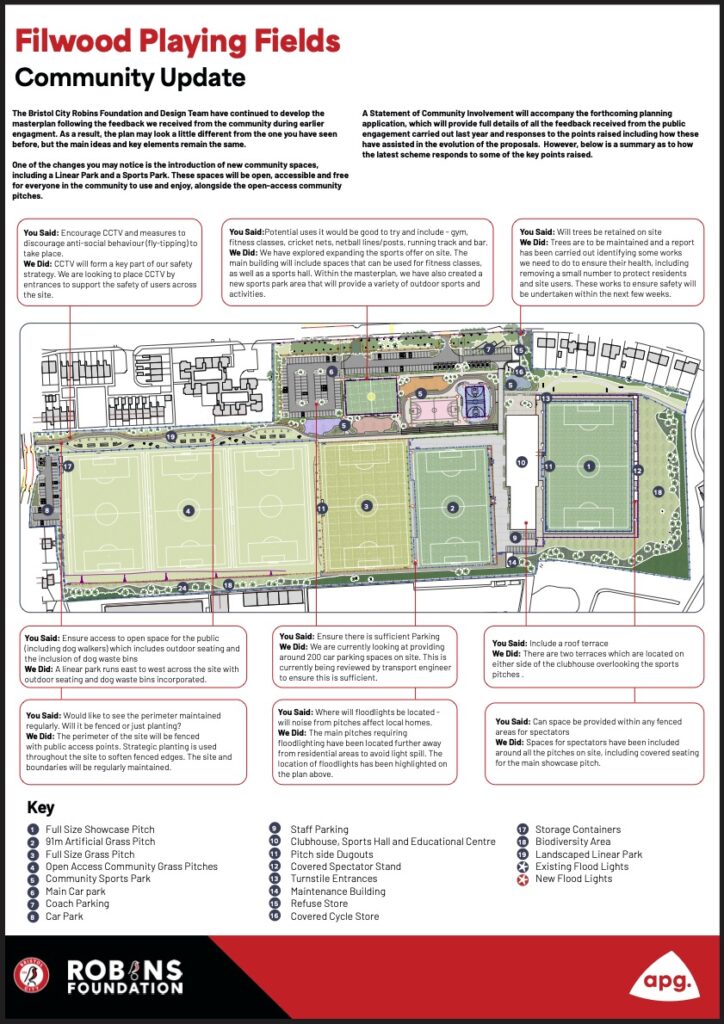
Fundamentally, the scheme remains the same: retention/improvements to existing playing pitches, new playing pitches and erection of a new Sports and Education Hub Building, however, some of the main changes relate to the introduction of a greater level of community / amenity space alongside the Multi-Use Games Area (MUGA).
Tetlow King, and the design team working with the Robins Foundation are now working on the final details for the planning application submission, which will be submitted to Bristol City Council.
Below is information on the updated plans and how the design team and the Robins Foundation have responded to suggestions and feedback.
Trees
At the engagement event, a number of local residents raised concern about the trees, particularly weak and falling branches, and movement. Specific work has been carried out to assess the health and condition of the trees along Creswicke Road. There has been Arboricultural Condition and Safety Assessment for the trees, as a result there will be some work to the trees.
Some of the trees are covered by a Tree Preservation Order (TPO), therefore, an application to carry out the suggested works to the trees is being prepared and will be submitted to Bristol City Council in the coming days.
Once permission for the works has been granted, residents might see some activity at the site as the works are carried out. This is not work commencing on the redevelopment proposals but is separate health and safety tree work.
All the poplar trees on the site frontage are within falling distance of Creswicke Road, housing, parking, a public footpath, playing field, and in some instances the changing rooms. This makes the frequency of targets and associated hazard high, meaning an assessment of the trees is important.
All the trees are generally in good condition. However, most of the trees have minor deadwood within the crowns. This is consistent with the age (mature, and early mature trees) and the type of tree; poplar trees. Where deadwood is overhanging the road, it has the potential to cause damage. There is a plan to remove some branches and this will happen within next few weeks, together with the removal of some ivy from one of the trees that is close to the road, removal of the ivy will allow improved inspection of the tree.
One of the tree exhibits “crown dieback”, likely caused by stress associated with competition from surrounding trees and exacerbated by a period of drought in the summer of 2025. Another tree shows root damage likely associated with historic mower damage, investigation with a metal probe indicated the presence of “advanced cubical brown rot”. An assessment made shows that the felling of these trees is recommended and these two trees will be felled within the next 6 months.
All trees should be checked for protected species e.g. roosting bats and nesting birds prior to any works
being undertaken. Failure to undertake adequate inspections that result in the disturbance of protected species may result in the contravention of national wildlife legislation and the committing of a criminal offence.
It has been recommended that the trees are inspected on an annual rotation and after major storm events. The inspections should alternate between growing and dormant season to allow the assessment of foliage as well as the winter canopy.